 weekbloom
Why do I feel exhausted after work every day?
If you feel exhausted after work every day, it’s usually not one big problem but the shape of your day: hours of effort with no real pause, a mind that keeps working after you log off, and evenings and nights that don’t refill the tank. Change those three things a little, and you get some of your evening back.
The short answer. Most after-work exhaustion comes from five everyday causes:
- Your work takes constant mental effort, even sitting down.
- You take no real breaks during the day.
- Your mind keeps working after you leave.
- You sleep less than you need.
- Your evenings don’t actually recharge you.
The good news: each one has a small fix you can try this week.
Why do I feel exhausted after work if I sit all day?
A desk job can leave you as tired as a physical one. Your body barely moves, but your mind never stops: focusing, deciding, replying, staying calm on a tense call. All of that is effort.
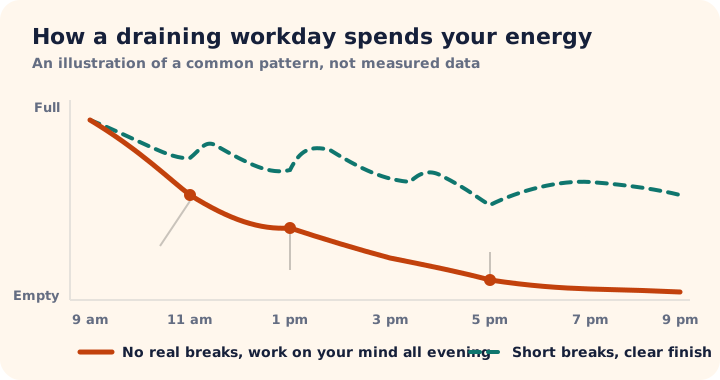
Picture an ordinary Tuesday. A 9 am meeting runs into a 10 am meeting. In between, twelve messages arrive. Lunch is a sandwich over the keyboard. At 6 pm you close the laptop, and you’ve been “on” for nine hours straight without a single real pause.
You didn’t do anything dramatic. You just never stopped. That steady, unbroken effort is what empties you by the evening.
Try this: for one day, notice which moments leave you most drained. For many people it’s back-to-back meetings or constant small interruptions, not the hard, focused work itself.
You take no real breaks during the day
What’s going on: short pauses refill a bit of energy, and most of us skip them.
A 2022 review that pooled 22 study samples looked at micro-breaks: pauses of 10 minutes or less. People who took them felt a little more energetic and a little less fatigued (Albulescu et al., 2022). The effects were small, but real.
There’s a catch. The same review found that short breaks didn’t clearly help people perform better at demanding work, and longer breaks seemed to help more there. So a two-minute stretch helps you feel better, while a heavy morning may call for a proper lunch away from your desk.
Try this: a real break means leaving the task. Switching from a spreadsheet to work chat doesn’t count. Standing up, getting water, looking out of a window or walking around the block does. Aim for one every hour or two.
Your mind keeps working after you leave
What’s going on: you stop working at 6 pm, but your head doesn’t. You replay a meeting on the way home, check email “just once” after dinner, and plan tomorrow in the shower.
Researchers call the opposite “psychological detachment”: not thinking about work in your free time. A large review of 86 publications covering over 38,000 employees found that people who detach more tend to report less exhaustion, less fatigue and better sleep (Wendsche & Lohmann-Haislah, 2017). Most of those studies measured people at one moment in time, so they show a link rather than proof that one causes the other. Still, the link shows up again and again.
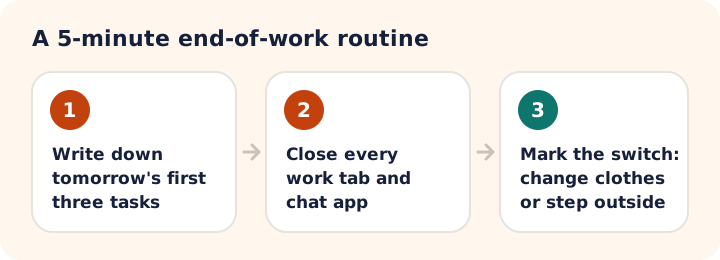
Try this: give your workday a clear ending. It’s much easier to stop thinking about work when you’ve told your brain the day is done.
You’re not getting enough sleep
What’s going on: it sounds obvious, but it’s often the biggest piece. The CDC says adults need at least 7 hours of sleep each day. If you get six on work nights, feeling wiped out after work is your body keeping score.
There’s a common trap here. Late evening is often the only time that feels like yours, so you stretch it out. That makes sense. But staying up borrows from tomorrow, so the next workday feels harder, and you want even more evening time to make up for it. Round and round.
Try this: pick a regular bedtime for work nights and set an alarm 30 minutes before it as a “start winding down” reminder.
You skip movement because you’re tired
What’s going on: when you’re drained, the sofa feels like the only option. But gentle movement can leave you with more energy, not less.
In a small University of Georgia study, inactive people who often felt tired rode an exercise bike for 20 minutes, three times a week, for six weeks. Both the easy and the moderate groups reported more energy than people who didn’t exercise, and the easy group reported the biggest drop in fatigue (University of Georgia, 2008). It was a small study, but the message is encouraging: you don’t need a hard workout.
Try this: walk part of your commute, or take a 20-minute stroll before dinner. Easy is fine. Easy might even be better.
Your evenings don’t actually recharge you
What’s going on: not all free time is restful. Scrolling, catching up on chores and half-watching a show while answering messages can fill a whole evening without giving anything back.
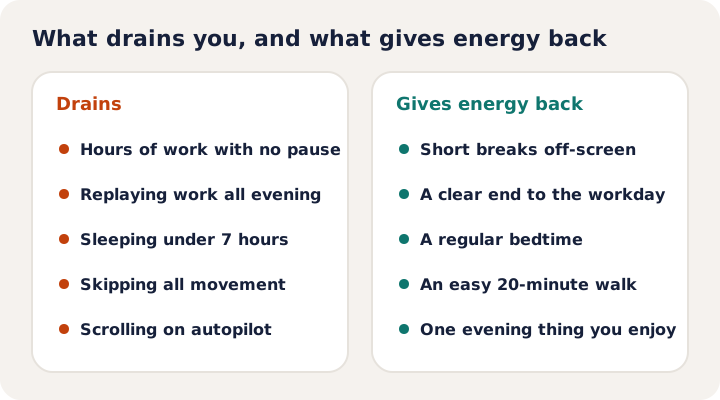
Try this: sort your usual evening activities into two piles: the ones that leave you feeling better afterwards, and the ones that leave you the same or worse. The first pile is usually short and specific: cooking something simple, a call with a friend, reading, music, a walk.
You don’t need to fill every evening with them. One recharging thing on your hardest weekday can change how the whole week feels. It’s the same reason so many people feel tired on weekends: the week spends the energy first.
A simple plan for this week
Big resolutions tend to fade by Wednesday. A small if-then plan is easier to keep, because it ties a new habit to a moment that already happens every day. Pick one and write it down:
- If it’s 11 am and I’ve been at my desk since 9, then I stand up and get water away from my screen.
- If I close my laptop at the end of the day, then I write tomorrow’s top three tasks and close every work tab.
- If it’s a weekday evening after dinner, then I walk for 15 minutes before I sit down.
Plan B for rough days: if the full plan feels like too much, do the smallest version. Two minutes outside instead of fifteen still counts.
Find your own pattern in one week
Exhaustion after work rarely has a single cause, and yours may not look like anyone else’s. The quickest way to find out is to keep a tiny note each evening: how much energy you have left, from 1 to 5, plus one line about the day.
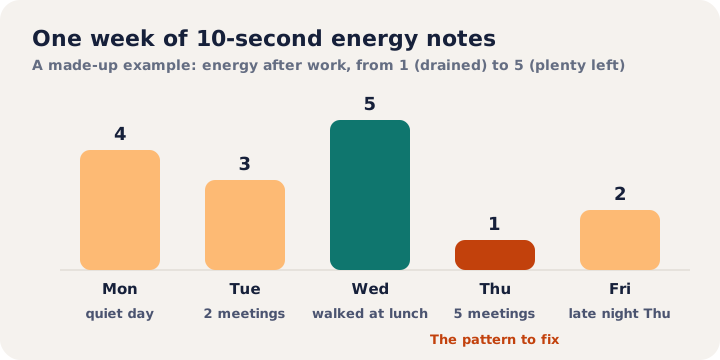
After a week or two, a pattern usually shows up. Maybe Mondays are fine and Thursdays are terrible. Maybe your best days are the ones where you got outside at lunch. Once you can see it, you can fix the one thing that matters most instead of trying to change everything at once.
Weekbloom is built around this idea: a few seconds a day to rate your energy, and it shows you which days and habits drain you most.
When to get help
Feeling tired after a long day is normal. But if you feel exhausted most days for several weeks, even after rest and good sleep, or if it comes with low mood, please talk to a doctor. They can check whether something else is going on, and you deserve support. If your job itself feels overwhelming, a mental health professional can help too.